


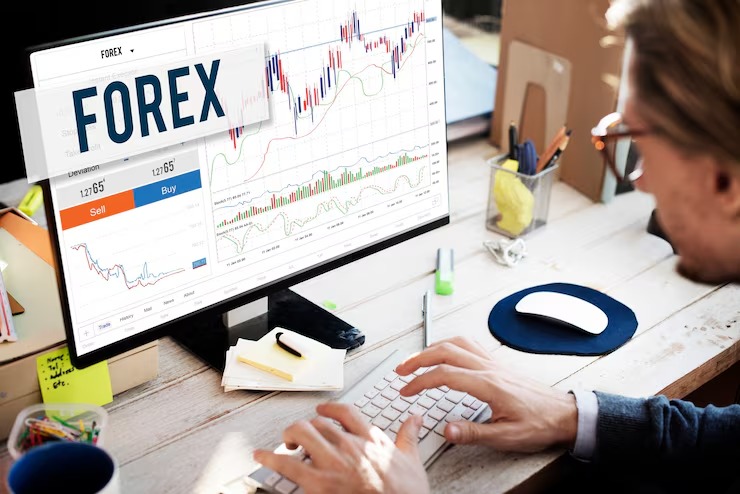
What Is Forex Trading?
Forex trading, short for foreign exchange trading, involves buying one currency while simultaneously selling another. The objective is generally to speculate on changes in the relative value of currencies, although foreign exchange markets also play a fundamental role in international trade, investment and risk management.
Unlike buying a share in a company, forex trading involves a currency pair. When a trader buys EUR/USD, for example, they are effectively buying euros relative to the US dollar. When they sell EUR/USD, they are taking the opposite view.
Understanding this structure is essential because currency prices are influenced by a wide range of factors, including interest rates, inflation, economic growth, central-bank policy, political developments and market sentiment. For Australian traders, movements in the Australian dollar and US dollar can be particularly relevant because Australia’s economy is closely connected to international trade and global financial markets.
Forex can provide opportunities to participate in global markets, but it is also complex and can involve substantial risk, particularly when trading leveraged products.
How Does Forex Trading Work?
Forex is based on the relative value of one currency against another.
Currencies are quoted in pairs, such as:
- EUR/USD – euro against US dollar
- GBP/USD – British pound against US dollar
- USD/JPY – US dollar against Japanese yen
- AUD/USD – Australian dollar against US dollar
- USD/CAD – US dollar against Canadian dollar
The first currency is known as the base currency, while the second is the quote currency.For example, suppose AUD/USD is quoted at:0.6600This means one Australian dollar is worth 0.66 US dollars.If a trader believes the Australian dollar will strengthen against the US dollar, they may take a long position in AUD/USD.If they believe the Australian dollar will weaken, they may take a short position.The trading result depends on the direction and size of the currency movement, as well as the size of the position and applicable trading costs.
What Moves Currency Prices?
Currencies do not have a single fundamental driver. Their prices reflect the constantly changing relationship between two economies.Several factors are particularly important.
Interest Rates
Interest-rate expectations are among the most closely watched influences in foreign exchange markets.When investors expect interest rates in one country to rise relative to another, the currency relationship can change as market participants reassess the relative attractiveness of assets denominated in those currencies.Central-bank decisions therefore receive considerable attention from forex traders.For an Australian trader, decisions and communication from the Reserve Bank of Australia (RBA) can influence expectations for the Australian dollar, while decisions from the US Federal Reserve can influence the US dollar.However, markets often react to expectations before an official interest-rate decision occurs.
Inflation
Inflation affects currencies through several channels.Persistent inflation can influence expectations for monetary policy, while central banks may adjust interest rates in response to changing inflation conditions.Traders therefore monitor inflation reports not simply because prices are rising, but because inflation can influence future monetary policy and interest-rate expectations.
Economic Growth
Economic activity can also affect currency valuations.
Traders may monitor:
- GDP growth
- Employment data
- Consumer spending
- Retail sales
- Manufacturing activity
- Business investment
- Trade figures
Stronger economic expectations can sometimes support a currency, but the relationship is not automatic. Markets consider how economic developments compare with expectations and how they affect monetary policy.
Political and Geopolitical Developments
Political uncertainty, elections, government policy and geopolitical events can influence currency markets.During periods of significant uncertainty, investors may adjust their exposure to different currencies and assets.The reaction can be difficult to predict because the same event can have different implications depending on the broader economic environment.
Market Sentiment
Currency markets are also influenced by investor positioning and overall risk sentiment.When investors become more concerned about economic or financial conditions, demand for certain currencies can change. When confidence improves, capital may move toward assets perceived as offering greater growth or risk exposure.This is one reason currency markets can move sharply even when there has been no major change in economic data.
Understanding a Forex Quote
Consider a hypothetical EUR/USD quote:
EUR/USD = 1.0850 The euro is the base currency and the US dollar is the quote currency.This means one euro is worth 1.0850 US dollars.If the quote later rises to 1.0950, the euro has strengthened relative to the US dollar.If it falls to 1.0750, the euro has weakened relative to the US dollar.The size of a currency movement is commonly discussed in pips, although the exact convention can vary depending on the currency pair and quoting system.For many major currency pairs, a pip represents the fourth decimal place. For yen-denominated pairs, the convention is commonly different.Traders should understand the specific pricing convention of the instrument they are trading.
What Are Long and Short Forex Trades?
Forex allows traders to take positions in either direction.Going LongA trader goes long when they expect the base currency to strengthen relative to the quote currency.For example, a hypothetical trader buys AUD/USD at 0.6600.If the pair rises to 0.6700, the trade has moved favourably before considering costs.Going ShortA trader goes short when they expect the base currency to weaken relative to the quote currency.Suppose the same hypothetical trader sells AUD/USD at 0.6600.If the pair falls to 0.6500, the trade has moved favourably before costs.These examples are purely hypothetical and do not represent actual trading performance.
What Is the Forex Market?
Forex is a global, decentralised market rather than a single exchange.
Foreign exchange transactions involve participants such as:
- Commercial banks
- Central banks
- Investment institutions
- Corporations
- Fund managers
- Foreign exchange providers
- Retail traders
Unlike shares listed on an exchange such as the ASX, spot foreign exchange is generally traded through a network of market participants rather than through one central exchange.This structure contributes to the global and highly interconnected nature of currency markets.
Why Is Forex Important?
Forex is important far beyond speculative trading.Businesses use foreign exchange markets when they conduct international transactions. An Australian company importing products from the United States, for example, may need to exchange Australian dollars for US dollars.Investors may also need to convert currencies when buying foreign assets.Governments and financial institutions participate in currency markets for various operational and policy-related purposes.For traders, understanding this broader function helps explain why exchange rates can respond to economic developments around the world.
What Makes Forex Different From Share Trading?
Forex and share markets are fundamentally different.
| Feature | Forex | Shares |
| Main asset | Currency | Company ownership |
| Pricing | Currency pair | Individual security |
| Market structure | Primarily decentralised/OTC for spot FX | Commonly exchange-traded |
| Key drivers | Interest rates, economic data, currencies, policy | Earnings, valuations, company performance and market conditions |
| Direction | Long and short exposure commonly available | Depends on the product and market |
| Leverage | Common in retail forex products | Depends on the product |
| Currency exposure | Central to the trade | May be indirect or additional |
The distinction matters because the analytical framework for currencies is different from that used for individual companies.
What Is Leverage in Forex?
Leverage allows a trader to control a larger market exposure relative to the funds committed as margin.For example, a hypothetical position with $1,000 of margin could provide exposure to a position worth more than $1,000, depending on the product and applicable conditions.This can magnify both gains and losses.A relatively small currency movement can therefore have a significant effect on the trader’s account.ASIC has repeatedly warned Australian investors about the risks of leveraged foreign exchange and other OTC derivatives. ASIC describes margin FX as a complex and risky product and highlights the importance of understanding leverage, volatility, market conditions and counterparty risk.For Australian retail clients, the regulatory framework also places restrictions on leverage for certain CFD products. The applicable rules depend on the specific product and circumstances, so traders should check current product documentation rather than relying on a generic leverage figure.
Potential Advantages of Forex Trading
Forex trading has characteristics that can make the market relevant to certain traders.
Global Market Exposure
Currency markets provide exposure to economic relationships between countries and regions.
Two-Way Trading
Traders can potentially take long or short positions, depending on the product and trading arrangement.
Broad Range of Currency Pairs
Major, minor and some emerging-market currency pairs may be available, depending on the provider.
Macroeconomic Analysis
Forex offers a market through which traders can study and express views on interest rates, inflation, economic growth and monetary policy.
Australian Dollar Exposure
For Australian traders, currency pairs involving the AUD can provide a direct way to analyse developments affecting the Australian economy and its major trading relationships.The Reserve Bank of Australia notes that the AUD/USD is one of the key measures of the Australian dollar exchange rate and that the US dollar is the dominant currency against which most currencies are traded.
Limitations and Risks
Forex trading also has significant limitations.
Currency Markets Are Difficult to Predict
Exchange rates respond to numerous variables, often simultaneously. Even experienced traders can be wrong about the direction or timing of a move.
Leverage Can Magnify Losses
Leverage increases market exposure and can make relatively small price movements financially significant.
Volatility Can Increase Quickly
Economic announcements, central-bank decisions and unexpected events can cause rapid price movements.
Trading Costs Matter
Spreads, commissions, financing charges and other costs can affect trading results, depending on the product and provider.
Counterparty Risk
For OTC forex and derivative products, traders should understand who provides the product, how pricing works and what arrangements apply to client funds and obligations.
Currency Risk Can Be Complex
A trader can be correct about one economic trend while overlooking another currency factor that moves the exchange rate in the opposite direction.
Common Forex Trading Mistakes
Trading Without Understanding Currency Pairs
A trader should understand exactly what is being bought and sold before entering a position.
Using Excessive Leverage
A large position may create significant losses from relatively small price movements.
Ignoring Economic Events
Interest-rate decisions, inflation reports and employment data can produce substantial volatility.
Overtrading
Frequent trading can increase costs and encourage decisions based on short-term market noise rather than a well-defined process.
Treating Past Performance as a Guarantee
A strategy that performed well under one market environment may behave differently under another.
Following Unverified Signals
Copying trades or relying on unsupported predictions does not replace understanding the market and managing risk.
A Practical Approach to Analysing Forex
A disciplined trader can begin with a structured process.
Step 1: Choose the Currency Pair
Understand the two economies represented by the pair.
Step 2: Identify Major Drivers
Review interest rates, inflation, economic growth and central-bank expectations.
Step 3: Check the Market Calendar
Be aware of major scheduled economic releases and policy decisions.
Step 4: Analyse Price Behaviour
Technical analysis can be used to study trends, support and resistance, volatility and market structure.
Step 5: Calculate Potential Exposure
Before entering a trade, understand position size, pip value, margin and the financial effect of different price movements.
Step 6: Define Risk
Consider how much capital is at risk and what would cause the trading idea to be invalidated.
Step 7: Review the Trade
Afterwards, assess the decision-making process rather than judging the trade solely by whether it made or lost money.
Australian Considerations for Forex Traders
Australian traders should pay particular attention to the type of forex product they are using.There is an important difference between participating in the underlying foreign exchange market and trading a retail derivative such as margin FX or a CFD.
Before opening an account or position, traders should understand:
- Who provides the product
- Whether it is an OTC derivative
- How prices are determined
- What leverage applies
- How margin is calculated
- What spreads and other costs apply
- How overnight financing works
- What happens during volatile markets
- How client-money arrangements operate
- What protections and contractual terms apply
ASIC’s current regulatory work continues to emphasise the risks associated with complex and leveraged retail products. In a 2026 review, ASIC reported that CFDs remained high-risk, complex OTC derivatives and noted that leverage and financing costs can magnify losses.This is particularly important for anyone considering forex trading primarily because of its leverage rather than because they understand the underlying market.
A Simple Hypothetical Forex Example
Suppose a trader believes the Australian dollar will strengthen against the US dollar.The hypothetical AUD/USD exchange rate is:0.6600The trader opens a long position.Later, AUD/USD rises to:0.6650The position has moved in the trader’s favour.However, the final result would depend on the position size, the product used, transaction costs, financing charges and the exact entry and exit prices.If AUD/USD instead falls to 0.6550, the position would move against the trader.This simple example demonstrates why direction alone is not enough. Position sizing and risk management determine how strongly a price movement affects an account.
Key Takeaways
Forex trading is the buying and selling of currencies relative to one another. It is a global market influenced by monetary policy, economic conditions, inflation, interest rates, political developments and investor sentiment.
The most important points are:
- Forex is traded in currency pairs.
- The first currency is the base currency; the second is the quote currency.
- Currency prices reflect the relative value of two currencies.
- Interest rates and central-bank expectations are important market drivers.
- Economic data and geopolitical developments can cause significant volatility.
- Leverage can magnify both gains and losses.
- Australian traders should understand the specific forex or derivative product they are using.
- AUD/USD is particularly relevant to Australian market participants.
- Trading costs, margin, liquidity and counterparty arrangements matter.
- A strong understanding of risk is as important as market analysis.